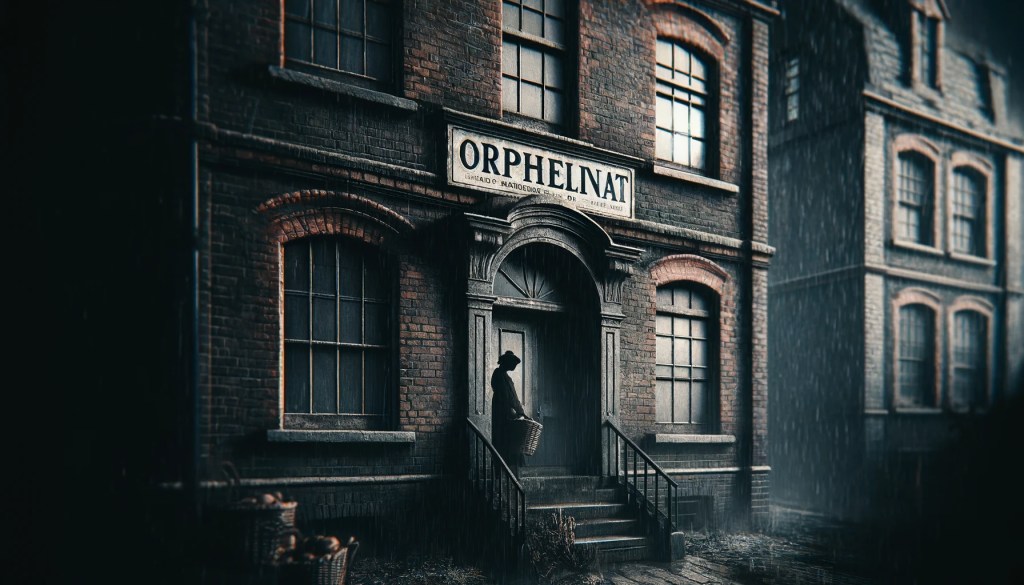
Paris, 1832
I creep down the stairs of the orphanage, wiping my sweaty forehead.
Madame Fournier is very ill. Our roles have reversed; it is up to me now to take care of her.
The days have grown long since the dreaded disease crept into our walls.
At the start of the month, there were five of us children, all sharing the dream of being placed in a loving home. That hasn’t happened in a while, but our numbers have dwindled regardless. It’s just me now, and Madame holds on by a thread.
Cholera. It has devoured the lot of Paris, and the lot of our orphanage.
I haven’t succumbed yet, though it feels inevitable.
The hour is late. I lean against the cold window, watching the rain pour onto the city streets. The people of Paris never sleep, it seems. Noise from outside seeps through the glass.
Someday, I shall build a life for myself outside of the city. Far away from illness and chaos.
Not today, I remind myself as Madame coughs upstairs. She needs me now.
Tears roll slowly down my face. I am worried for Madame, and for the orphanage I’ve grown up in.
What will become of it if she dies?
I am only sixteen. I could never take on the role of headmistress; not without Madame’s instructions.
I reach into my pocket and pull out an envelope she had given me while I was in her room just now.
Cleore, for your future. Love, Madame.
Inside is ten francs.
I frown. Surely she hasn’t lost all hope that she’ll recover.
I curl up in one of Madame’s chairs.
My eyes are heavy with anxiety and fatigue, and the night is growing dark.
The rain is like a lullaby, like Madame used to sing to us.
La nuit porte des conseils, she would whisper. The night carries advice.
I fall asleep quickly, praying the night does as it should.
***
A loud banging awakes me, and my heart jumps in my throat. My eyes dart to the window.
It is still night, and the rain has not stopped.
Another knock echoes through the building.
Someone is at the door.
I gather my breath and stumble to my feet.
The door creaks as I open it.
At first I see no one, and for a moment I wonder if I am losing my sanity.
But when I glance down, my eyes widen.
At my feet lies a baby, soaked and squirming in her basket. She seems no more than a few weeks old, and skinny as a whip.
By first instinct, I bring the baby inside.
I am not a stranger to caring for children. Dozens of babies have arrived on our doorstep over the years.
But usually, Madame is here to assist.
Under the basket is a note.
Mother sick with cholera, it reads. Take care of Eugénie.
Eugénie.
I glance down at baby Eugénie, who sucks her little thumb in silence.
How small she is, with such a big life ahead of her.
I frown as I remember the other children.
If Eugénie stays here, she risks cutting her life short.
I take a breath and offer her my finger to hold. What can I do to help this baby? Surely she’ll die in the city on her own.
I fetch the envelope from my pocket.
There is little hope for Madame now, and she knows it.
I can’t do much more here.
But if I take this child elsewhere, I could spare her life.
I could spare my own life.
My heart quickens and I swallow hard. I lift Eugénie from the basket and hold her close to my chest.
I place the ten francs in my pocket and take one last look at the building that raised me.
“Goodbye, Madame Fournier,” I sigh.
I wipe away a single tear and hurry out the door.
The Parisian air is brisk, and I wrap the baby tight in her swaddle.
The rain has stopped, and the clouds part to reveal a full moon.
The next steps are unclear, though I am confident in one thing.
We shall go somewhere, free of sickness and death.
We shall build a life outside of the city.
And perhaps someday, I shall return to the orphanage.
For now, I must face the darkening night.
Eugénie lets out a small whimper.
“Do not be afraid of the dark,” I whisper to her.
“La nuit porte des conseils. The night carries advice.”

 Madison Esshaki
Leave a reply to #itsmenick! Cancel reply